

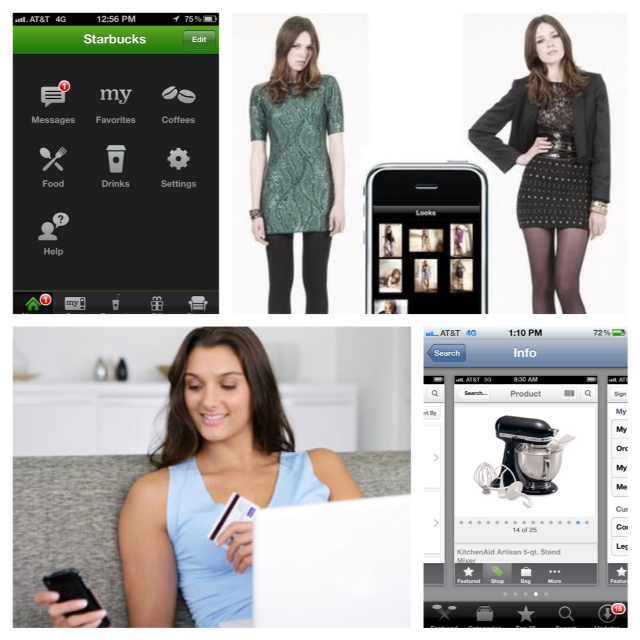
In recent years, Smart phones have evolved from a means to simply communicate to a device with the ability to entertain through music and video, provide directions, and even a venue for online shopping. Findings from the National College Student Survey, by research firm DigitalMediaIX, show that more than 75% of students use their smart phones to shop. While music and mobile apps continue to be the most important categories, clothing, food, and electronics have emerged as important growth segments.
Smart phones provide both challenges and opportunities for retailers. Mobile e-commerce (MEC) is dramatically changing the retail industry, pushing traditional brick and mortar stores to become more innovative in regards to their selling approaches. Often people use their smart phones while shopping at traditional stores to not only get peer reviews of products, but also price-check.
Based on the large percentage of college students that are currently using mobile devices for purchases, it is important to understand which retailers have been able to connect with this demographic. In other words, which companies have been able to create a mobile shopping experience that encourages a customer to buy a product from their phones.
Research shows a number of well-known brands taking the lead in MEC. Starbucks, Kohl’s, Amazon, and Apple each play an active role in MEC, with varying degrees of success. Each of them is experimenting with different approaches to MEC and are striving to create a satisfying customer experience on the “small screen.”
Starbucks is one of the more innovative companies in MEC. The coffee retailer has a very successful mobile app and the company continues to increase the services it supports. Starbucks’ app enables customers to perform many functions, including payments, gift card redemptions, and the ability to locate nearby stores. It virtually eliminates the need for customers to carry cash or a physical gift card. Customers can even earn points through the My Starbucks Reward program, which automatically records every purchase to their accounts via their phones.
An informal survey of college students shows a surprisingly large number who used the Starbucks app to purchase coffee. One student says that her purchases actually increased from the retailer, as a result of the app. She says, “the app makes it so much easier to just swing into Starbucks and I don’t feel guilty because I have all my gift cards and points loaded on my iPhone.” This is a dream scenario for any retailer—making purchasing more convenient and increasing the wallet share of current customers.
College Women Shop for Clothing with their Smart Phones
DigitalMediaIX’s survey also finds that 58% of college women use their mobile phone to purchase clothing. This statistic reveals how important it is for retailers to have strategy to support MEC. With college students always on the move, retailers that can attract them to a mobile site will likely add incremental business.
One clothing retailer, Kohl’s, is able to capitalize on this emerging trend by offering an exceptional mobile experience. Research shows that consumers want a mobile site that either offers additional benefits or one that creates a seamless shopping experience. Kohl’s mobile site satisfies the latter and makes mobile shopping easier than ever. While their mobile site is not flashy, it is often recognized for its ease-of-use, which reflects the company’s image.
Amazon is another retailer disrupting the norms of online shopping, especially on mobile devices. Its mobile site is relatively simple and enables consumers to participate in the growing trend of showrooming. Showrooming occurs when a consumer uses their mobile device to comparison shop while in a brick and mortar store. While this is a concern for retailers with physical stores, it is a huge growth opportunity for online retailers like Amazon. Amazon’s mobile site allows consumers to view and interact with products in a physical store and order the product at a lower price on their phones, often through the Amazon online store.
Amazon’s mobile site enables consumers to capture sales from many of their competitors, even in unexpected categories. While showrooming is typically done with expensive categories, such as electronics, it is also becoming more popular in apparel, consumer products, and toiletries. One student mentions that he uses his phone and AmazonPrime account to order everyday essentials such as cereal, socks, and granola bars. Why? He claims it saves him time and money, and is more convenient than tracking the newest deals at supermarkets and big box retailers. Plus, when he uses his smart phone to make the purchases, he can buy the items at a time that is convenient for him. Other students report using their mobile phone to browse, making the actual purchase later in a physical store or on their computer.
One retail brand that ranks high in customer satisfaction, but has less than stellar reviews for their mobile shopping experience, is Apple. While their MEC sales rank among the highest, trailing only Amazon, customers tend to be unsatisfied with the overall experience. Apple customers may be disenchanted with their mobile site due to the high expectations that are set by their impressive brick and mortar shopping experience. It does not appear that this will create any major set-backs for the retailing giant, but it would be interesting to see what an improved mobile experience could do for the company’s sales.
Retailers have often subscribed to the maxim, “location, location, location.” With customers spending more time online and often relying on smart phones, retailers need to address both the virtual and mobile consumer. Kohl’s and Starbucks are connecting with these customer segments; they excel in promoting their brands and as a result, they are rapidly growing from the MEC programs. Amazon is successful in capturing business by allowing customers to use their mobile devices to compare products while shopping in a physical store. While not all retailers are living up to their customer’s expectations when it comes to mobile shopping, there are strong indications that this market will enjoy continued success and the retailers that embrace a MEC strategy will thrive in the future.



Photos Courtesy of UW-Madison Archives
